“Information can inform. Experience can transform.”
In a world overflowing with information, transformation remains surprisingly rare. What changes people is not what they know – it is what they experience, reflect upon, and apply.
We live in an age where information is abundant.
Professionals can access courses, webinars, podcasts, articles, and AI-generated insights within seconds. Yet despite unprecedented access to knowledge, meaningful change remains elusive for many individuals and organizations. The reason is simple: information alone rarely transforms people. Transformational learning occurs when knowledge is combined with experience, reflection, and action.
The Information Paradox
Modern professionals consume more information than any previous generation. However, knowing more does not automatically result in better decisions, stronger leadership, or lasting behavioral change. Reading about leadership does not make someone a leader. Understanding innovation does not guarantee innovative behavior. The gap between knowing and doing remains one of the greatest challenges in professional development.
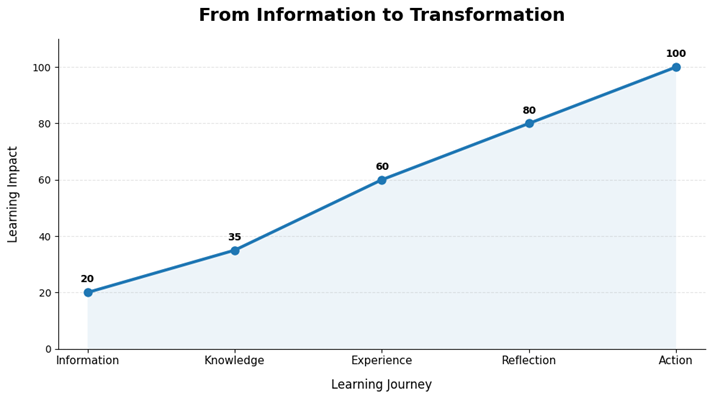
Transformational learning occurs when information is reinforced through experience, deepened through reflection, and sustained through action.
What is transformational learning?
Transformational learning goes beyond acquiring facts or skills. It involves a shift in perspective, mindset, assumptions, and behaviors. Rather than simply adding new information, transformational learning changes how people understand themselves, others, and the world around them. It creates lasting change because it influences identity rather than just knowledge.
Why experience is the catalyst for transformation?
Experience creates emotional engagement, making lessons memorable and meaningful. Real-world situations challenge existing assumptions, expose blind spots, and force individuals to confront complexity. Experience also makes learning personal. When people connect lessons to their own lives and challenges, learning becomes relevant and actionable. Most importantly, experience builds confidence through action, turning theory into capability.
The critical role of reflection
Experience alone is not enough. People can go through the same event and learn completely different lessons. Reflection helps transform experience into insight. By asking questions such as ‘What happened?’, ‘Why did it happen?’, and ‘What will I do differently next time?’, professionals deepen self-awareness and accelerate growth. Reflection converts events into learning opportunities.
Transformational Learning in professional development
Leadership development is most effective when leaders face real challenges, make decisions, and learn from outcomes. Teams grow through shared experiences and collaborative reflection. Organizations innovate when employees are encouraged to experiment, learn from failure, and apply insights to future initiatives. Change management becomes more effective when learning is embedded in actual workplace experiences rather than theoretical training alone.
How organizations can foster transformational learning ?
Organizations can encourage transformational learning by creating safe environments for experimentation, promoting reflective practices, supporting coaching and mentoring, and prioritizing experiential learning opportunities. Businesses that celebrate learning alongside performance outcomes create cultures of continuous improvement and adaptability.
The future of learning in an AI-driven world
As artificial intelligence makes information increasingly accessible, knowledge itself is becoming a commodity. Competitive advantage will belong to professionals who can interpret experiences, think critically, adapt quickly, and continuously learn. Human transformation, rather than information accumulation will become the defining factor of success.
Information can fill minds, but experience can change lives. Transformational learning occurs when experience, reflection, and action work together to create meaningful growth. Professionals and organizations that embrace experiential learning will be better prepared to navigate complexity, develop stronger leaders, and achieve sustainable success in a rapidly changing world.
Ready to move beyond information to transformation?
At Kabir Learning Foundation, we believe meaningful growth happens when learning becomes an experience, not just an event. Through experiential learning, reflective inquiry, leadership development, coaching, and immersive learning journeys, we help individuals and organizations turn knowledge into lasting change.
If you are looking to build reflective leaders, adaptive teams, and a culture of continuous learning, let’s start the conversation.
Connect with Kabir Learning Foundation to explore transformational learning experiences for your people and your organization.
Frequently Asked Questions
What is transformational learning?
A learning process that changes perspectives, beliefs, and behaviors rather than simply increasing knowledge.
Experience creates relevance, emotional engagement, and opportunities for practical application.
Yes. Real-world projects, leadership challenges, reflection, and coaching all support transformational learning.
Traditional learning focuses on knowledge acquisition, while transformational learning focuses on changing perspectives, behaviors, and actions.
By creating opportunities for experimentation, reflection, feedback, and continuous development.